Guías de Viaje



The Ávila - El Paraíso
Cachimbo - Piedra del Indio
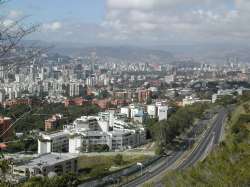
View to the cota mil
The raise to the Avila from Cachimbo is one of the most interesting. It is not so popular asSabas Nieves o La Julia, but it has many charms. It is longer (from 2 to 3 times more than Sabas Nieves), less frequented and you reach a higher point, therefore, a better view.
The path has shade, practically in all its extension. The raise is for some moments soft, but in general is pretty strong. Approximately at the third part of the way, there is a water faucet and later on, a water tank. This is the last chance to drink some water until “El Paraiso” and afterwards there are no other water tanks.
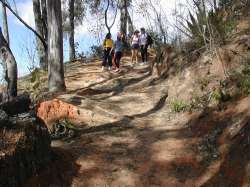
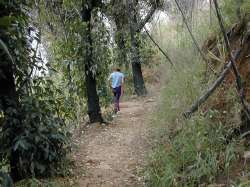
In each corner of the way you can watch the city or the rest of the mountain.
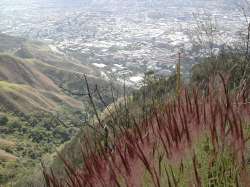
The red herbs that in an epoch of the year give a special color to the Avila
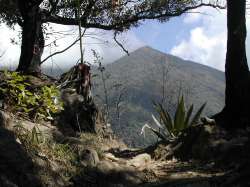
Watching to the east you see the path that leads to the Naiguata Peak
Suddenly, the way under the trees ends and you can see the “Piedra del Indio” (the stone of the aborigine), in the middle of a very steep hillside.
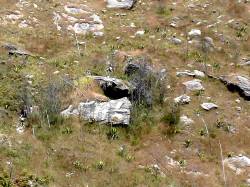
The “ Piedra del Indio”
To arrive to the “Piedra del Indio” you must keep on walking for a while, but there is enough energy because our goal is very close. The path passes above the stone; therefore, you must descend a little to get to it. It is the ideal place to rest and admire the city, from 1600 meters above the sea level.
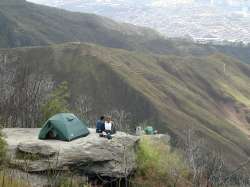
Tent in “La piedra del Indio”. Behind, the Estribo de Duarte and at the bottom the East of Caracas
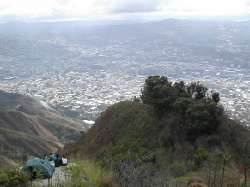
Down to the left, the tent in “La Piedra del Indio”.
Very soon the path splits: To the Oriental Peak, and going on East, El Paraíso.
El Paraíso
One of the things that most amazes the excursionist is the change of vegetation that you live when you go to the gully Los Chorros (Tocome), in the place known as “El Paraiso” (The Paradise). In effect, you change from vegetation without trees to a deep jungle.
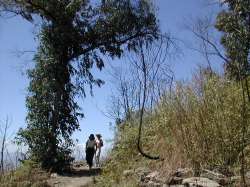
The first trees that announce the change of vegetation.
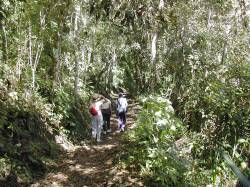
The deep jungle that leads to the Tocome gully.
When you get to the jungle, the way down starts, which lasts approximately half an hour. It is a beautiful way.
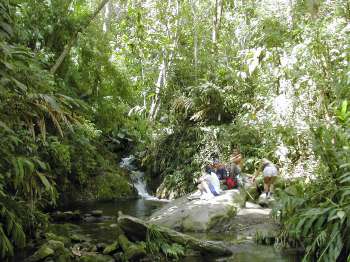
The Tocome gully, also known as Los Chorros
Finally, we get to the Tocome gully in a place called “Paraíso” (Paradise). For those who know the Avila, this is one of the most beautiful places. You can bath in the gully, although the water is pretty cold. There are two or three wells where you can also jump.
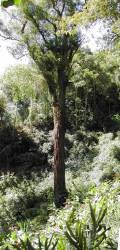
Giant Eucalypt
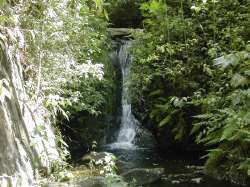
Cascade
We follow our path to the East, looking for the exit of the Avila by the Estribo de Duarte. In this side the vegetation is less thick. The spaces in the trees allow a very nice view of the Oriental (Eastern) Peak.
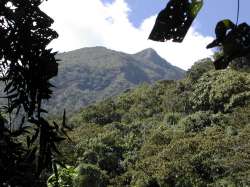
The Oriental(Eastern) Peak
A few minutes after, the jungle ends and we appreciate, again, a nice view of the east of Caracas. We are arriving to the Estribo de Duarte.
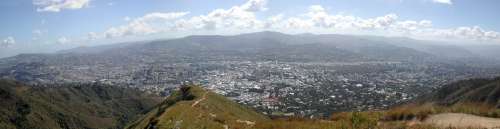
Estribo de Duarte
The Estribo de Duarte (Stirrup of Duarte) is one of the hardest and probably less agreeable raises due to its steepness and lack of trees. The vegetation is in its majority grass and it is probable that due to this fact, it is one of the places that most suffers fires in the dry season.
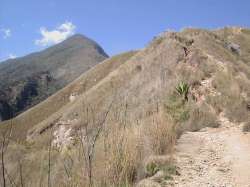
Steep raise and without trees, at the end the Eastern Peak
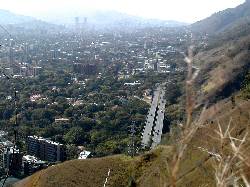
View to the cota Mil and the viaduct of Los Chorros
The National Park Ranger’s place is one of most beautiful, maybe with the exception of the one in Los Venados. It has several huts in which you can make some reunions.
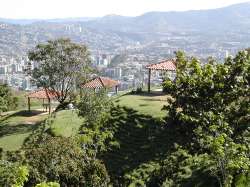
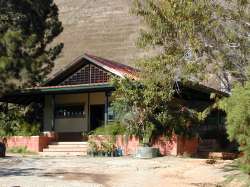
We end our journey here, returning to the city. When we turn around, we observe the National Park Ranger’s house and the Eastern Peak.
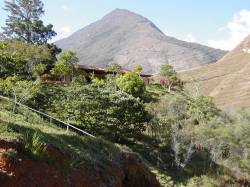
National Ranger’s Park and Eastern Peak
Ver además
| Caracas - With a population around 4 million, Caracas is the capital and more populated city in Venezuela. It is located close to the Coast (La Guaira Port), but at an altitude of 800 meters (2400 feet), which gives it an unique climate. |
||
| Fire cutter - One of the most interesting features of the firewall is in the variety of environment. We go from the sun to the shade. From the deep remote jungle of the world to the proximity of the city |
| The Avila - Eastern Peak - There are two ways to get to the Eastern Peak: From Sabas Nieves (the west side) and also from Cachimbo (the east side). In this page we’ll narrate the raise from Cachimbo and the Aborigine Stone |

Fin Espacio Publicitario