Guías de Viaje



The Avila - Eastern Peak
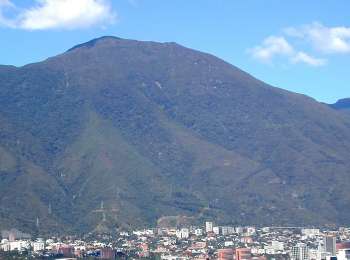
The Eastern Peak, viewed from “Colinas de Valle Arriba”
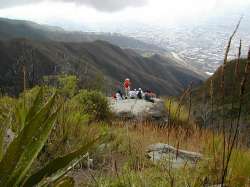
The Aborigine Stone
There are two ways to get to the Eastern Peak: From Sabas Nieves (the west side) and also from Cachimbo (the east side). The first option is a little easier than the second. In this page we’ll narrate the raise from Cachimbo and the Aborigine Stone (Piedra del Indio). The raise by the other side is very similar to the one of the Western Peal and it only changes in the final part.
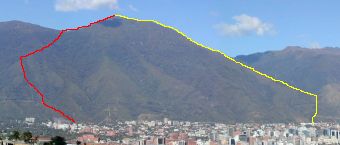
In red the route of Sabas Nieves and in yellow the route of Cachimbo
We can say that the route of Cachimbo divides itself in 3 big parts of similar length:
- • From the National Park Ranger’s place of Cachimbo to the Aborigine Stone (Piedra del Indio) (1500m). See the description in the site of Paraiso.
- • From the Aborigine Stone to the “Cabeza de Elefante” (2100m)
- • From “Cabeza de Elefante” to the “Cruz de los palmeros” (Palmers Cross) and at short distance from there to the summit of the Eastern Peak
Each one of these phases can be done in between 45 minutes (sometimes even less) and 90 minutes, depending on the preparation and athletic conditions of the excursionist.
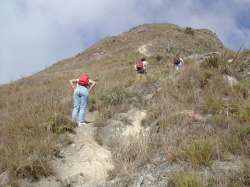
Strong raise without trees
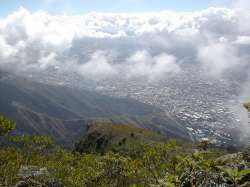
The sight of the East of Caracas
Once you’ve gotten to the Piedra del Indio, you must continue to the East (trough the right side). Not long after having passed a group of 4 or 5 trees and before getting into a jungle with numerous trees, you must look for a path of raise, a little difficult to find, due that its starts with a rock hard t climb, because it does not offer any support point. It is the only point really hard to accomplish.
In this second phase of the excursion, the raise is very strong and there aren’t almost trees. If it isn’t cloudy, the sun can be very strong. It is important to take with you lots of liquids, due that there aren’t wells or where to drink water in the whole raise.
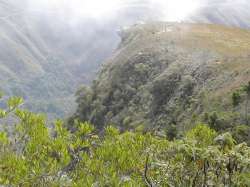
“Cabeza de Elefante” (Elefant Head), seen from above
The great goal that we await is the “Cabeza de Elefante” (Elephant head). There is a rock that is like a viewing point, with a nice sight: Bellow, the East of Caracas, in one side the thick and deep jungle where “El Paraiso” is to be found, to the bottom the “Fila Maestra” (main row) and above us, the Eastern Peak.
Shortly after in our third phase, the vegetation changes completely. The Savannah is left behind and we start to see the bushes and Ferns that protect you from the sun.
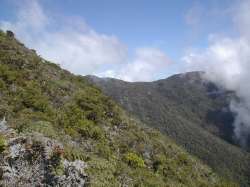
The Fila Maestra (Master Row): behind, the north part that leads to the see.
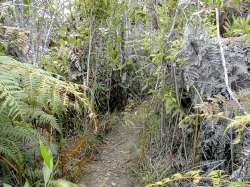
The vegetation with bushes offers the excursionist protection from the sun
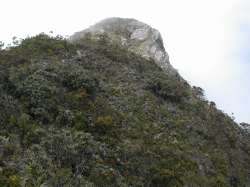
Behind the hill, the Eastern Peak
During the entire phase, you watch a hill that can be confused with our goal. You suddenly see behind the hill another hill, that is really the east park of the Eastern Peak (Pico Oriental)
Finally, you arrive to the famous “Cruz de los Palmeros” (palmers cross), that can be seen from the city, mainly in the afternoons, when the sun makes it shine. They are several huge rocks there. On weekends, many excursionist sit over them to watch the spectacular landscape, enjoying of a fresh breeze and the satisfaction of having arrived.
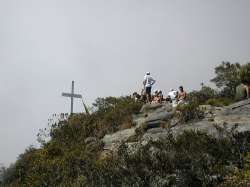
The Palmers Cross
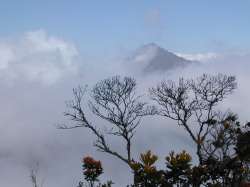
In between the clouds, the Naiguata Peak
The view is awesome. Looking down in the south direction, the city. In the other side, looking north, the sea; to the east the Naiguata Peak, and to the west, at a very short distance, the summit of the Eastern Peak.
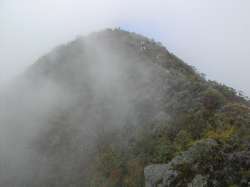
The summit of the Eastern Peak
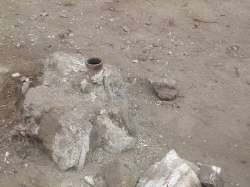
The sign that indicates the top of the summit
After about 15 minutes of easy march, you get from the palmers cross to the summit of the Eastern Peak. There, in the highest point, there is a small cut tube that indicates that in some moment there was a signal. The height is 1620 meters above sea level.
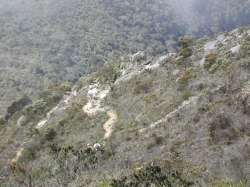
The western side of the Easter Peak. A very hard path to accomplish
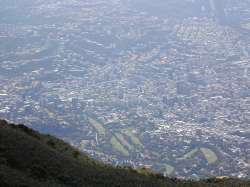
View of Caracas. At first sight, the golf court of the Caracas Country Club
From there, you must decide the way down: you can simply return or go to the Silla de Caracas, “No te Apures” and “Sabas Nieves. We took the second option. The west path of the Eastern Peak is very steep. This way has the peculiarity that many paths cross themselves, but they all lead to the same place: the Chair of Caracas (Silla de Caracas)
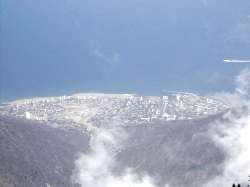
The see at the level of Caraballeda. The boat on the right is the ferry that goes from La Guaira to Margarita
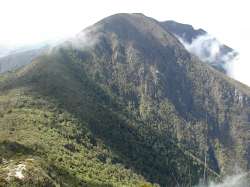
The Western Peak, seen from the road on the west of the Eastern Peak.
On the way down, as shown in the picture bellow, you can see in one side Caracas and in the other side the coast, separated by the Avila.
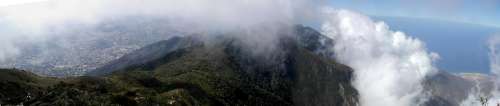
Panoramic view
Once you are in the chair of Caracas (Silla de Caracas), you can continue to the Western Peak (Pico Occidental), Lagunazo and the Cable-Car, or well continue descending.
See the page of the Western Peak.
Ver además
| El Ávila - La Julia - The national park El Avila, that separates the city of Caracas from the coast, offers many excursions. One of these excursions is to the national park ranger’s place of “La Julia” located 1140 meters above sea level. |
| The Avila - Papelón - On one of the Northwestern points of the city, at the level of San Bernardino, you find the route to the national park rangers place “Loma del Viento”. To get there, you can park in the Avila Hotel and start your way up in the mountain, precisely in the entry of the park. |
| Chacaito Gully - There are to ways to get to the Chacaito Gully: From the Park Rangers Place Chacaito or from Sabas Nieves. The best option is to get from one point and leave by the other. In this narration we start from Chacaito. |
| The Avila - Chacaito - In the Geographic center of Caracas, at the level of Chacaito, you find the raise to the national park ranger’s place Chacaito, in the national park El Avila. |

Fin Espacio Publicitario