Guías de Viaje



Maracaibo lake western coast
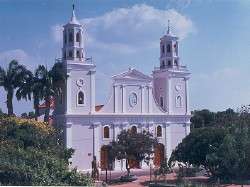
Main Church of Altagracia Ports
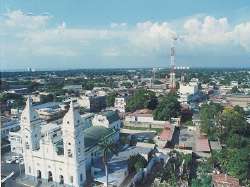
Cabimas general view
Maracaibo Lake Western Coast is among the richest Venezuelan lands in oil as well as in fertile soils. This zone is full of beautiful landscapes that spread from the exotic Miranda beaches, where Cienaga de Los Olivitos (Olivitos Swamp) and Mar de Quisiro (Quisiro Sea) are, to the oil scenery sprinkled with palafito villages ("villages in the lake") like Ceuta and San Timoteo, at the southern part of this coast.
On this coast there is Cabimas that was named so by the aborigines, who took the name from the "cabimo", a huge medicinal tree that grows in the zone.
In 1829 Cabimas became an Ecclesiastic Parish of Altagracia district. Between 1830 and 1835 it was promoted to Civil Parish and between 1870 and 1904 it was risen to Municipal District.
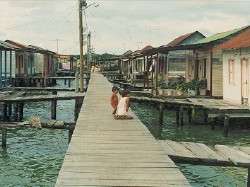
Palafitos (houses over the water) at Ceuta
Ceuta and San Timoteo are among the main "pueblos de agua" (villages in the lake"). Ceuta celebrates the old traditional San Benito's dance in the water, thus becoming the only village that honours the black Saint this way. The celebration is a good opportunity to watch the large amount of these "palafitos" still inhabited.
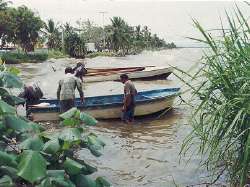
Fishermen at San Timoteo
Bachaquero is another important "pueblo de agua" ("village in the lake"), which took its name from the enormous nests made in the zone by the "bachacos" (huge ants extremely destructive), that sometimes reached a hight of 50 to 80 m.
Until September 1st 1938, when the first oil well was drilled, the main economic source in town was the fishing industry, but from that moment on the oil industry took over and it has been ever since, in a way or another, the platform of all the economic activities of the zone.
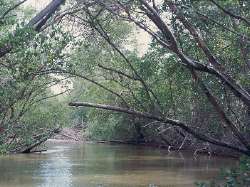
La Cienaga de Los Olivitos (Olivitos Swamp)

Complejo Petroquimico El Tablazo (El Tablazo Petrochemical Complex)
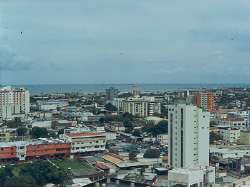
Lagunillas general view
This name comes from the small lagoons (lagunillas in Spanish) that formed by the overflowing of a bigger one at the mouth of Pueblo Viejo River. In this region there are natural oil springs, which were used by the Indians for curative purposes. This practice induced the Spanish Queen to bring to Spain some of the substance, hoping it could heal The King Carlos V from his lung illness.
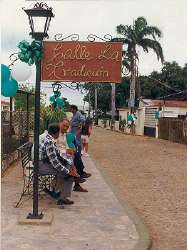
Calle La Tradicion (Tradition Street)
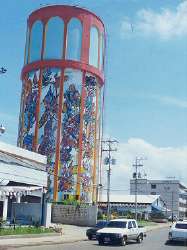
Mural en Lagunillas (Mural at Lagunillas)
Since Colony times Lagunillas has gone through an economic process that deepened during the first years of the 20th century, when it changed from a main port of the agricultural Venezuelan age, into one of the most significant centres of today's Venezuelan oil industry.
More than the 60% of Maracaibo Lake oil production centres on Lagunillas which has the largest oil reserves of the region.
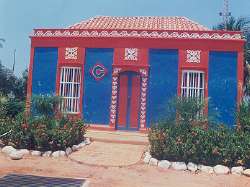
Santa Rita typical house
Among the relevant towns of Maracaibo Lake Western Coast, there is Santa Rita that has a wide range of economic sources such as the chemical, livestock and tanning industries.
Ver además
| Antipasto - En mi casa cada vez que se hacían fiestas o reuniones cada miembro de la familia que asistía colaboraba llevando algún plato, bien fueran pasapalos, ensaladas ó ponches, para hacer de la velada un momento delicioso donde compartir y festejar. |
| Los Hervidos - El hervido ó sancocho es una sopa con gran contenido de ingredientes y aliños que le dan un sabor muy característico, se acostumbra a preparar en todas las regiones del país, es un plato nacional que puede encontrarse en cualquiera de nuestras ciudades y |
| Zulia - El estado Zulia está localizado al extremo noroccidental del país, siendo sus limites el Golfo de Venezuela por el norte, Colombia por el oeste, Táchira, Mérida y Trujillo por el sur y los estados Lara y Falcón por el este. |
| House cleaners of Zulia - These lizards belong to the great cosmopolitan family of the "geckos ", called Gekkonidae. Numerous species inhabit the tropics and are well-known to live inside or near human dwellings, where they are usually seen walking at night by walls and roofs, hun |
| La Batalla del Lago de Maracaibo - Librada el 24 de julio de 1823 resultó una acción decisiva en las campañas navales de la Independencia. En dicha batalla se enfrentó la escuadra republicana dirigida por el general José Prudencio Padilla, comandante del tercer departamento de Marina y de |



Fin Espacio Publicitario